Best Time to Visit the Moluccas: When Sea and Rhythm Shape the Journey
“In the Moluccas, timing is shaped as much by the sea as by the weather itself.”
Timing works differently in the Moluccas
When people ask about the best time to visit the Moluccas, the answer is usually framed around dry seasons and rainfall. And while weather certainly matters here, travelling through the islands quickly reveals that timing is shaped by something else just as strongly: the sea itself.
Distances between islands may not appear enormous on a map, but once you begin moving through the region, the rhythm of travel changes completely. Ferries, speedboats and weather conditions shape daily movement in ways that are difficult to fully understand beforehand. A crossing that looks simple online can feel entirely different once you are out on open water.
That is also one of the reasons why we deliberately travelled through the Moluccas in April. Not because we were searching for guaranteed sunshine, but because calmer sea conditions generally make movement between islands more manageable, particularly when travelling further out towards places like Banda.
In the Moluccas, the sea quietly determines much of the journey.
The dry season and calmer seas
In general, the period between roughly April and November is considered the best time to visit the Moluccas. During these months, the weather is often drier, the sea calmer and travel between islands more predictable.
That predictability matters more here than it might elsewhere in Indonesia.
Boat crossings are a central part of travelling through the islands. Ferries connect larger routes, while smaller speedboats often link places like Ambon, Saparua and more remote villages or islands. When the sea becomes rough, movement slows down quickly. Delays become normal, routes may change and crossings can become significantly more intense.
During our own journey, the calmer conditions in April made a noticeable difference. Crossings between islands still felt long, but they remained manageable and relatively smooth. Travelling towards Banda across open water especially highlighted how dependent the experience is on sea conditions.
The same applies to snorkelling and diving.
Places like the Banda Islands are known for their coral reefs, visibility and marine life, but those experiences are heavily influenced by currents, waves and underwater visibility. Calmer seas generally create better conditions not only for reaching these islands safely, but also for experiencing what lies beneath the surface once you arrive.
If you want to understand more about travelling towards Banda itself, I wrote more about that journey in Discovering the Enchanting Banda Islands.
What travelling during wetter periods can change
Outside the drier months, travelling through the Moluccas can become less predictable. Rain itself is not always the biggest issue. Tropical showers often come and go quickly. The larger factor is how changing weather patterns affect the sea.
Waves become rougher. Smaller boats move differently. Delays become more common. And plans may need to shift unexpectedly.
That does not necessarily mean travelling during these months is impossible. Life across the islands continues as normal, and local communities are highly accustomed to adapting to changing conditions. But for visitors moving between multiple islands, flexibility becomes even more important.
This is also why rigid itineraries rarely fit the rhythm of the Moluccas particularly well.
The islands do not move according to tightly controlled schedules. Boats leave when conditions allow. Distances take longer than expected. Conversations extend. Delays happen. And gradually, you begin adjusting your expectations accordingly.
At some point, travel stops feeling like a sequence of reservations and starts feeling more connected to the pace of the islands themselves.
The sea shapes travel more than the weather itself
What stood out most during our time in the Moluccas was how strongly the sea shapes everyday movement across the region.
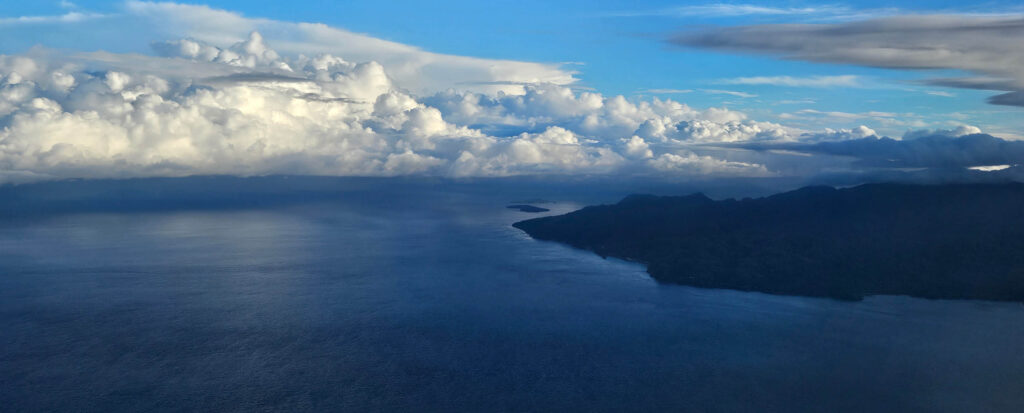
Travelling between Ambon, Saparua and Banda was not simply transportation between destinations. The crossings themselves became part of the experience. Long stretches of open water, changing light, volcanic islands slowly appearing on the horizon, and hours spent moving between places without urgency gradually created a completely different sense of distance.
The geography of the Maluku Islands itself partly explains why sea conditions influence travel so strongly across the region. The sea constantly reminds you that movement here is never entirely controlled.
Even with organised transport, timings shifted regularly. Boats departed later than planned. Conditions changed. Routes adapted. Yet none of it felt chaotic once you accepted that flexibility was simply part of daily life across the islands.
That rhythm becomes especially visible on smaller islands like Saparua, where movement, weather and daily life seem closely connected to one another.
I wrote more about that slower island rhythm in Saparua Island Indonesia: An Authentic Rhythm of Everyday Life.
Why slowing down matters in the Moluccas
One of the easiest mistakes when planning a journey through the Moluccas is trying to move too quickly.
Because while the islands may appear close together geographically, travelling between them often takes far longer than expected. Not only because of transport itself, but because movement through the region naturally unfolds more slowly.
Boats become part of the day. Waiting becomes normal. Harbours, crossings and changing schedules gradually shape the rhythm of travel itself.
Trying to visit too many islands within a short timeframe often means spending more time organising movement than actually experiencing the places you came to see.
That is one of the reasons why combining islands like Banda and Saparua works particularly well when you have enough time available. The contrast between them adds depth to the journey, while their relative proximity within the wider region still makes the route practical.
For those planning routes between islands across the region, I wrote more about the practical side of travelling through the archipelago in How to Travel to the Moluccas.
The longer you stay, the more the islands begin to reveal themselves beyond first impressions.
So when is the best time to visit the Moluccas?
For most travellers, the period between April and November will generally offer the calmest and most practical conditions for travelling through the Moluccas, especially when island hopping or travelling further towards Banda.
But perhaps the more important question is not simply when to visit, but how.
Because travelling here depends less on finding perfect conditions and more on allowing enough time for the islands to unfold gradually. The sea, the distances and the rhythm of daily life all shape the experience in ways that are difficult to fully predict beforehand.
And that unpredictability is part of what makes the Moluccas feel different from many other destinations.
“The islands are not experienced between fixed points on a schedule, but somewhere in the movement between them.”


An open question
Perhaps places like the Moluccas are not remembered most clearly because of what was seen there, but because of the way they slowly reshape expectations around time, movement and attention itself.
Travel here rarely unfolds according to fixed schedules or carefully controlled plans. Boats leave later than expected, crossings take longer, and distances feel different once they are measured through weather, sea conditions and waiting rather than efficiency.
But somewhere within that slower rhythm, another way of travelling gradually becomes visible. One where movement matters less than presence, and where adapting to a place becomes more important than trying to control it.
What changes when travel stops revolving around perfect timing, and begins to move instead with the rhythm of the place itself?
Continue Exploring The Moluccas

Beyond ferries and island crossings, daily life in the Moluccas is also shaped through schools, communities and small local initiatives that quietly influence entire generations.
Travelling through the Maluku Islands gradually shifts your sense of time, movement and what travel itself can become.