
Local Knowledge When Travelling: Why It Changes the Experience
Reflections on travelling with local guides and tour operators, and how their knowledge, networks and perspective often lead to deeper, less obvious experiences than large international companies.
Local knowledge when travelling: a different way of seeing a place
Travelling with local guides shifts where attention goes. Not because routes suddenly change dramatically, but because context is constantly added. Landscapes are not just passed through; they are explained, connected, and placed within daily life, history and habit. Nature, culture and timing are read as part of the same whole.
This is where local knowledge when travelling begins to change how a place is understood — not as a series of highlights, but as something continuous and interconnected.
This kind of knowledge does not come from manuals or fixed itineraries. It comes from being there, repeatedly.
Flexibility on the road
One of the most noticeable differences when travelling with local operators is flexibility. Routes are not rigid scripts, but frameworks. Decisions are discussed rather than enforced. When plans shift, the consequences are understood immediately.
On a journey in Uganda, for example, we considered adding an extra stop to visit a waterfall. The guide did not simply agree or refuse. Instead, he explained what it would mean in practice: a later arrival, missing the sunset at the lodge, and a different rhythm for the rest of the day. With that context, the choice became conscious rather than automatic.
Time was treated as something to work with, not against.
Access beyond the obvious
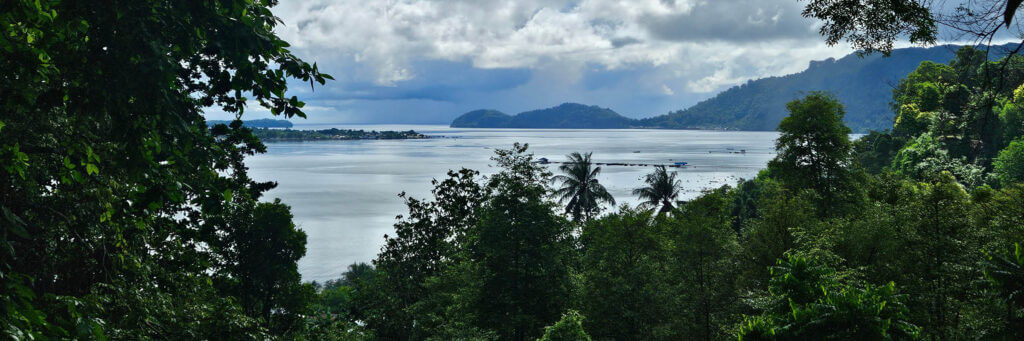
Local knowledge also opens doors that are otherwise invisible. On Borneo, time left between planned moments created space for detours — a canoe trip into narrow waterways, a walk through a small riverside village, an overnight stay that allowed the journey to continue more slowly the next day. None of this was advertised. It simply became possible because there was room to ask, and someone present who knew what could be done. These moments did not feel exceptional at the time. They felt natural.
This kind of access rarely comes from planning alone, but from being present with someone who understands how a place actually functions beyond what is visible on a map.
Scale, cost and perspective
Large international tour operators often work at a different scale. Groups are bigger, schedules tighter, routes fixed well in advance. That structure leaves little room to respond to what unfolds along the way. It also comes with a certain distance — between travellers and guides, between programme and place.
There is another difference that becomes apparent over time: cost. Journeys arranged through large companies often come with significantly higher price tags, while local operators — who actually guide, drive and host — receive only a fraction of that amount. Working directly with local guides not only allows more flexibility, it also shifts where money ends up.
What you pay for, and who benefits, are not always the same thing.
For those interested in how tourism affects local economies more broadly, organisations such as the World Tourism Organization (UNWTO) provide insight into how value is distributed across the travel industry.
Context within regions like Karamoja
In regions like north-eastern Uganda, this difference becomes even more apparent. Travelling through Karamoja is shaped less by fixed routes and more by understanding how distance, timing and local dynamics interact.
Without that context, movement through the region can feel fragmented, while with it, the same journey begins to form a coherent whole.

“Local knowledge when travelling doesn’t change the route — it changes what the route reveals.”
An open question
Local knowledge does not guarantee better travel. But it does change the conditions under which travel happens. Decisions become shared. Time is discussed rather than imposed. And places reveal themselves not only through highlights, but through what happens in between.
What changes most is not what you see, but how you are able to see it — and how much of a place becomes accessible once you understand its internal logic.
How much that matters is something each traveller answers differently.
Continue Exploring Travel Philosophy
A reflection on how time and presence gradually deepen the way places are experienced.
A region where understanding local rhythm and movement changes the entire experience of travel.
